If you've seen the headlines and wondered whether the government really has started handing over its UFO records, the answer is yes. Since 8 May 2026 the Pentagon has put out eight batches of UFO files, about 521 files in all, on a public website anyone can open. This page explains what's been released, what's actually in the files, and what they do and don't prove.
We'll keep this page up to date as new batches come out, so it's worth bookmarking.
Have Any UFO Files Been Released?
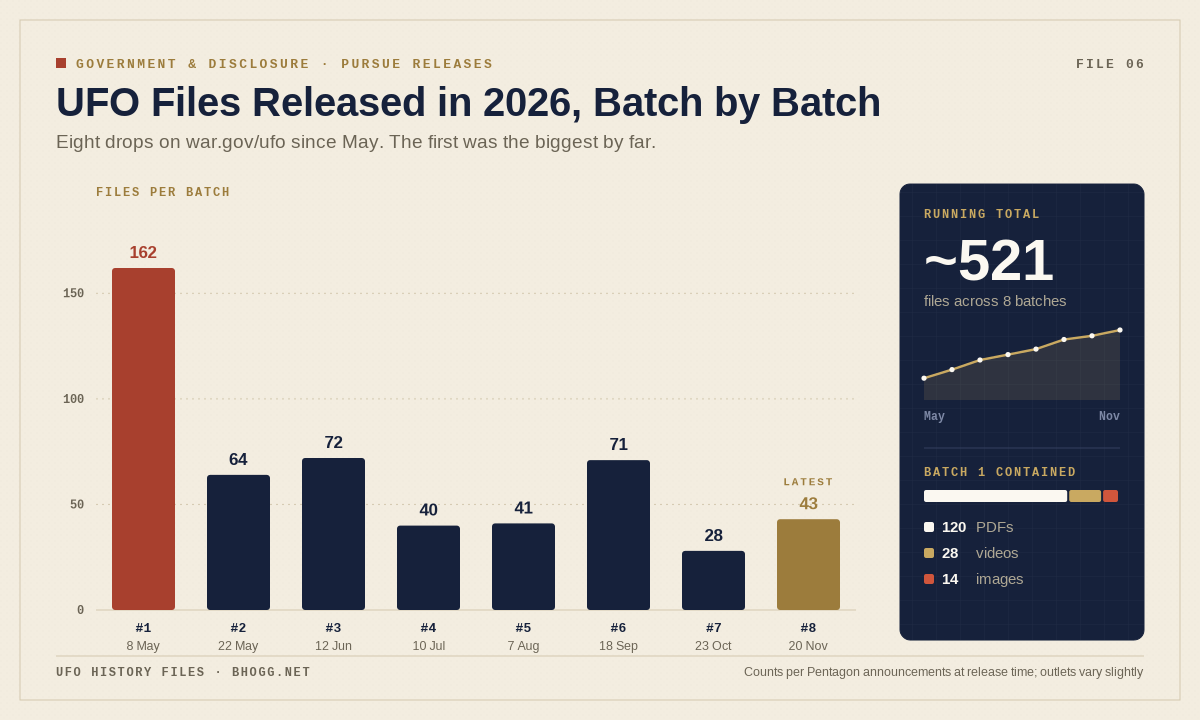
Yes, eight batches so far. The first went up on 8 May 2026, when the Department of War (the Trump administration's new name for the Department of Defense) launched a dedicated website, war.gov/ufo. That first drop had 162 files: 120 PDFs, 28 videos and 14 images. New batches have followed every two to five weeks since.
Here's every release in one place:
| Release | Date | Files | Highlights |
|---|---|---|---|
| 1 | 8 May 2026 | 162 | Apollo-era NASA photos and astronaut accounts, FBI case files, military "orb" videos |
| 2 | 22 May 2026 | 64 | Mostly videos (51), plus a 2025 account from an intelligence officer left "virtually speechless" |
| 3 | 12 June 2026 | 72 | Five federal agents' orb sightings with FBI renderings; a 2008 CIA report from Harare airport, Zimbabwe |
| 4 | 10 July 2026 | 40 | A military aviator's object "unlike anything" in 28 years of flying; a 2025 sensor track near China |
| 5 | 7 August 2026 | 41 | A huge triangle over Afghanistan in 2002; FBI witness forms; renderings of a 2026 western US incident |
| 6 | 18 September 2026 | 71 | The 1952 Tremonton, Utah film; Project Blue Book briefings; documents from the AAWSAP research programme |
| 7 | 23 October 2026 | 28 | A black triangle reported by federal agents near a secure site in 2026; a Roswell eyewitness statement |
| 8 | 20 November 2026 | 43 | A 2023 radar track at 55,000 to 70,000 feet; three Middle East military videos; the 1957 Levelland, Texas wave |
File counts come from the Pentagon's announcements and news reports at the time of each release. Different outlets count slightly differently, so treat the total as approximate.
Why Are UFO Files Being Released Now?
Two things came together. Congress had already ordered the Pentagon to start declassifying its UFO records back in 2022, after military pilots went public about strange encounters. Then in February 2026, President Trump said on Truth Social that, because of "tremendous interest", he would direct the Secretary of War and other agencies to start identifying and releasing government files on alien and extraterrestrial life.
The first batch arrived three months later. Defense Secretary Pete Hegseth said the files had "long fueled justified speculation" and that it was time for the public to see them. Officials have been clear that they aren't offering a verdict. The message from the start has been that people can look at the material and draw their own conclusions.
This is a big shift from how UFO records used to come out, a few pages at a time through freedom-of-information requests. If you want the background on how we got here, our guide to the difference between UFO and UAP disclosure explains the long road from rumours to official releases.
Where Can I View the Released UFO Files?
Everything is on the official site, war.gov/ufo. It isn't on AARO's own website (aaro.mil), which still confuses people. Here's the simplest way to use it:
- Open war.gov/ufo and scroll to the list of releases. Each batch has its own page, numbered 01 to 08.
- Pick a release and browse the files. Each one has a short official description, the agency it came from and the year.
- Open the PDFs, videos or images directly in your browser. Many documents are partly redacted, so expect blacked-out lines.
- Read the description before the file. It often tells you whether the case was later explained, which saves a lot of guesswork.
The site is popular. Pentagon officials said it had passed a billion hits within its first two weeks, so it can be slow when a new batch drops.
What's Actually in the UFO Files?
A mix of old and new. Some records go back to the late 1940s and the early flying saucer years. Others describe sightings from 2025 and 2026. Broadly, the files fall into a few groups:
- Military sensor videos. Mostly grainy infrared clips from fighter jets and drones, often showing small glowing orbs. Many come from operations in the Middle East and the Pacific.
- Witness accounts. Interviews with pilots, federal agents and intelligence officers, sometimes with artist's renderings made from their descriptions.
- Historical case files. FBI and Air Force records from the 1950s, including material connected to the big sighting waves of each decade.
- NASA material. Apollo mission photos, debriefs and transcripts where astronauts described things they couldn't identify.
- Diplomatic cables. State Department messages about incidents reported in other countries.
A lot of the reports cluster around military sites. That pattern isn't new, and we explain why in our article on UFO sightings near military bases.
Do the UFO Files Prove Aliens Exist?
No. This is the most important thing to understand about the release. The Pentagon labels these records "unresolved". That means investigators didn't have enough information to identify what was seen, not that anything was linked to alien life. When the first batch came out, officials also said many of the files had only been screened for security and hadn't yet been analysed to explain the sightings.
The government's own earlier findings point the same way. A Pentagon report in 2024 rejected claims that the US had recovered alien technology or confirmed evidence of alien life. Sean Kirkpatrick, the former head of AARO, warned that releasing files without analysis would mostly feed speculation and conspiracy theories.
Old cases are a good reminder of how this usually goes. The 1952 Tremonton film in release 6 was reviewed at the time, and the Robertson Panel later decided it probably showed birds. Many sightings end up having ordinary explanations. Our guide to UFO sightings that were later explained covers the usual suspects.
How Many UFO Files Are Released?
About 521 across the eight batches up to 20 November 2026. The biggest was the first (162 files) and the smallest was the seventh (28 documents). The files cover more than 70 years, from early Cold War memos to military footage filmed this year.
For context, that's only a small slice of the government's UFO paperwork. The US Air Force's Project Blue Book alone looked at more than 12,000 reports between 1952 and 1969. For the long-run numbers, see our page on UFO sightings statistics by year.
Will There Be Another Release of UFO Files?
Almost certainly. Each announcement so far has said the department and its partner agencies are "actively working on the next release" and will keep publishing "on a rolling basis". No date has been given for release 9. Going by the pattern (two to five weeks between batches), the next one could come in December 2026, but that's our estimate, not an official date.
We'll add each new batch to the table above as soon as it's published.
What Is NASA Saying About Aliens?
NASA's position hasn't changed. Its independent UAP study, which started in 2022, found no evidence that UAP come from outside Earth. NASA material does appear in the UFO files, mostly Apollo-era photos and astronaut transcripts. Several of those images had already been explained years ago as tiny meteoroid strikes, debris or camera faults. NASA's view is that UAP deserve better data and more scientific study, not that aliens are here.
What Do the UFOs in the Files Look Like?
Mostly glowing orbs, with some triangles, discs and cylinders. Orbs are the most common shape in the military videos, which matches civilian reports too. Triangles show up in several witness accounts, including the 2002 Afghanistan report and the 2026 sighting by federal agents. To see how these shapes compare, read types of UFO shapes explained.
If you want to see how strange-looking objects have been caught on video over the years, and why so much of it is blurry, our article on UFO sightings caught on camera is a good next read.
Is There a Documentary About UFOs?
Plenty. The one most people mean right now is The Age of Disclosure (2025), directed by Dan Farah and streaming on Amazon Prime Video. It interviews former military and intelligence officials and became the highest-grossing documentary on that platform. It's worth knowing that it argues for one side, so it's a good companion to the actual files rather than a replacement for them.
Frequently Asked Questions
Are the UFO files real?
Yes. They're official US government records published on a .gov website by the Department of War. What's "real" is the paperwork and footage. What the objects were is a separate question, and most cases are still unresolved.
When was the latest UFO files release?
The eighth release came out on 20 November 2026 and added 43 files: 40 documents and 3 military videos.
Who decides which UFO files get released?
The Department of War leads PURSUE with the White House, the Office of the Director of National Intelligence, the Department of Energy, NASA and the FBI. Files are reviewed for security before they go online, which is why many are partly redacted.
Can I report my own sighting to the government?
Members of the public can't add files to war.gov/ufo, but there are official and civilian ways to report what you saw. Our step-by-step guide on how to report a UFO sighting explains where to go.
The Bottom Line
The UFO files are the biggest public release of government UFO records ever, and they're genuinely interesting to dig through. But they're raw material, not answers. Read them the way a historian would: check the date, the source and the official description, and remember that "unresolved" just means nobody could pin it down at the time.
Want to know who's actually investigating all this? Our explainer on what AARO stands for covers the office behind the analysis.