If you've read any recent news about strange things in the sky, you've probably noticed the letters "UAP" showing up more than the old, familiar "UFO." So what's the real UAP vs UFO difference? It's not just a rebrand. There's an actual reason the U.S. government made the switch.
The switch matters for more than just style. It changed which reports get taken seriously, who feels comfortable submitting one, and how investigators categorize the evidence they collect. Understanding the reasoning behind the change makes it much easier to follow current news on this topic without getting confused by two terms that sound almost interchangeable but aren't quite.
Language shapes how seriously a topic gets treated, in government just as much as in everyday conversation. A pilot might hesitate to file a report using a word associated with science fiction movies, but feel comfortable using a more clinical, technical-sounding term for the exact same experience. That single psychological shift is a big part of why this terminology change happened at all.
What UFO Actually Stands For
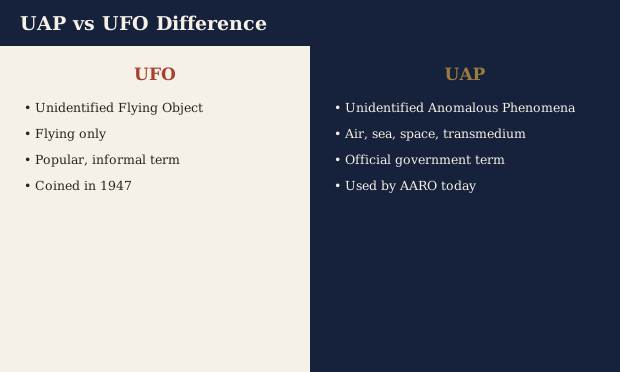
UFO stands for Unidentified Flying Object. It's a simple term: something is flying, and nobody has identified what it is yet. The term became popular in the late 1940s and, over the decades, it picked up a lot of extra baggage. For a lot of people, "UFO" now brings to mind aliens, flying saucers, and science fiction more than a serious government investigation.
What UAP Actually Stands For
UAP stands for Unidentified Anomalous Phenomena (it used to stand for Unidentified Aerial Phenomena, which is why you may see both). The word "anomalous" is doing a lot of work here. It doesn't just mean something flying. It can include objects seen underwater, objects that seem to move between air and water, or anything that behaves in a way current technology can't fully explain.
Broader Than "Flying"
This is the biggest part of the UAP vs UFO difference: UAP is a wider category. A UFO has to be flying. A UAP could be underwater, stationary, or moving in a way that doesn't fit into a neat "flying object" box at all.
Why the Government Made the Switch
Officials have said publicly that the word "UFO" carried too much cultural weight, making it hard for pilots and military personnel to report sightings without feeling like they'd be laughed at. Renaming the category to UAP was meant to strip away that stigma and encourage more accurate, less embarrassed reporting from trained observers like pilots and radar operators.
Does the Name Change Anything About the Evidence?
Not directly. Renaming a category doesn't make an event more or less real. What has changed is how seriously reports are investigated. Under the UAP label, cases are now reviewed with radar data, infrared footage, and multiple sensor readings, a very different process from the informal witness interviews used decades ago. You can read more about that shift in our article on what AARO stands for.
Are UFO and UAP Disclosure the Same Thing?
Not quite, and this trips a lot of people up. "Disclosure" refers to the release of information, documents, and video, while UFO and UAP are just names for the objects themselves. We break this down fully in our article on the UFO and UAP disclosure difference, since the two ideas often get mixed together in headlines.
Which Term Should You Use?
In casual conversation, "UFO" is still perfectly fine and everyone will know what you mean. If you're reading or writing about official government findings, "UAP" is the more accurate and current term. Either way, understanding the UAP vs UFO difference helps you read news coverage more carefully and spot when a headline is using the terms loosely.
Is UAP Just a Rebrand?
It's a fair question, and the honest answer is: partly, but not entirely. The name change was absolutely meant to reduce stigma and encourage more honest reporting from pilots who might otherwise stay quiet. But it also reflects a genuine, practical broadening of scope, since a category that only covers "flying" objects misses reports of unusual objects seen entering or moving through water, which turn out to be a real and recurring part of the reported data.
How Other Countries Handle the Terminology
The United States isn't alone in rethinking this language. Several other countries with active or historical UFO investigation programs, including France and the United Kingdom, have used their own official terms over the years, some closer to "aerial phenomena" and others sticking with more traditional language. There isn't yet a single global standard term, which is part of why international news coverage on this topic can feel inconsistent from one country's reporting to the next.
Frequently Asked Questions
Should I stop using the word UFO?
Not at all. UFO is still widely understood and perfectly fine for everyday conversation. UAP is simply the more precise term used in current official government reporting.
Does UAP include sightings by regular civilians?
Government UAP investigations focus mainly on military and government personnel reports, though civilian sightings are still tracked separately by organizations like NUFORC.
Will the term UAP eventually replace UFO completely?
It's possible in official and news contexts, but "UFO" is so deeply embedded in everyday language and pop culture that it's unlikely to disappear from casual conversation any time soon.
The Bottom Line
The UAP vs UFO difference comes down to precision and scope. UFO is the familiar, decades-old term for anything unidentified flying overhead. UAP is the newer, officially adopted term that covers a wider range of environments and comes with a more rigorous, sensor-based investigation process behind it. Knowing which term a source is using, and why, is one of the simplest ways to read UFO and UAP news more critically.
Keep Reading
For a step-by-step look at what happens after a sighting, see our guide on how to report a UFO sighting, or explore how many reports come in each year in our page on UFO sighting statistics by year.