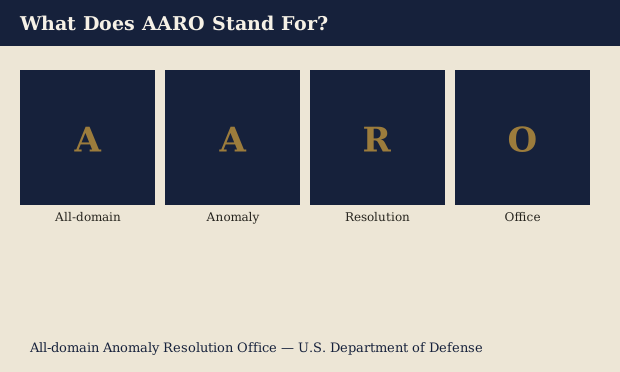
If you've come across the acronym in a news article and wondered, what does AARO stand for, here's the short answer: All-domain Anomaly Resolution Office. It's a real office inside the U.S. Department of Defense, and its entire job is to investigate reports of unidentified objects and events.
AARO doesn't investigate every strange light a person sees from their backyard. Its focus is much narrower and more formal: military and government reports, historical case reviews, and any data that comes with proper sensor backing. Understanding exactly what the office does, and doesn't, cover is the first step to reading its public reports accurately.
It's also worth knowing that AARO isn't the only government office that has ever tackled this topic, just the most recent and best resourced. Comparing it to earlier efforts helps show how much the process has matured, moving from occasional, under-funded task forces toward a permanent office with real legal authority and reporting obligations.
Breaking Down the Name
Each word in the name tells you something about the office's job:
- All-domain means it covers every environment: air, sea, space, and even underwater or "transmedium" objects that seem to move between them.
- Anomaly means something that doesn't fit the normal pattern of things we understand.
- Resolution means the goal is to actually solve the mystery, not just collect reports and file them away.
When and Why AARO Was Created
AARO was set up in 2022 after years of pressure from Congress and growing public interest, sparked partly by the release of Navy pilot videos showing objects moving in ways that didn't match known aircraft. Before AARO, UAP investigation was handled by smaller, less formal task forces that didn't have the resources or authority to dig deep into classified military reports.
How AARO Fits Into the Bigger Picture
AARO didn't appear out of nowhere. It's the latest in a long line of government efforts to investigate strange sky sightings, stretching back to Project Blue Book in the 1950s and 60s. You can see how those earlier efforts fit into the wider timeline in our article on UFO sightings by decade.
What AARO Actually Does Day to Day
AARO collects reports from military pilots, ships, and other government personnel, then investigates using radar logs, infrared video, and witness interviews. It also studies historical government records to see if older cases can finally be explained with modern knowledge. A large part of its public role is publishing declassified reports and case summaries so ordinary people can see what has actually been found.
Has AARO Found Evidence of Aliens?
As of AARO's public reporting, the office has stated it has found no verified evidence that any UAP report represents extraterrestrial technology. Most investigated cases are eventually traced back to drones, weather balloons, birds, camera glare, or classified aircraft that simply weren't public knowledge at the time of the sighting. A small percentage remain unresolved due to insufficient data, not confirmed alien activity.
AARO and the Word "UAP"
AARO's name and mission are a big part of why the term "UAP" has replaced "UFO" in most official government communication. We explain that full shift in our article on the UAP vs UFO difference.
AARO's Public Reporting Requirements
Unlike some earlier military investigation efforts, AARO is required by law to periodically report its findings, including historical case reviews, back to Congress and, in a limited form, to the public. This is a meaningful shift from the secrecy that surrounded earlier programs like Project Blue Book. AARO also maintains a public-facing website where it publishes declassified case files, historical record reviews, and summaries of its investigation methods, giving outside researchers a way to check its work rather than simply trusting an internal government conclusion.

Criticism of AARO
AARO hasn't escaped criticism. Some UAP researchers and members of Congress have argued the office moves too slowly, or that it doesn't have full access to every classified program that might be relevant to its investigations. Others have raised concerns that AARO's public reports lean too heavily toward mundane explanations without fully addressing the small number of genuinely puzzling cases. AARO's own leadership has responded by pointing to the sheer scale of historical records it has to review, some going back over seventy years, as a major reason full findings take time.
Frequently Asked Questions
Is AARO part of the CIA?
No. AARO is part of the Department of Defense, not an intelligence agency, though it does coordinate with intelligence agencies as part of its investigations.
Can the public submit a report directly to AARO?
AARO's primary reporting channels are built for military and government personnel. Civilians are generally directed toward organizations like NUFORC for logging sightings.
How is AARO different from Project Blue Book?
Blue Book operated decades ago with much more limited technology and far less public reporting. AARO benefits from modern radar, infrared sensors, and a legal requirement to report findings back to Congress, making its process considerably more transparent.
A Quick Snapshot of AARO's Scope
To summarize the office in a single glance: it covers air, sea, and space; it reports to Congress on a regular schedule; it reviews both new incoming reports and old historical case files; and its stated goal is resolution, not endless collection. That combination is what separates AARO from almost every government effort that came before it.
Why AARO Represents a Real Shift
Whatever conclusions AARO eventually reaches about individual cases, its very existence marks a real change in how seriously this topic is treated at an official level. A dedicated office, with a legal mandate, a public reporting requirement, and access to classified military data, is a very different thing from the informal task forces and quietly shelved programs that came before it.
Where to Learn More
To understand how AARO's findings differ from the broader idea of government "disclosure," read our breakdown of the UFO and UAP disclosure difference. For raw numbers on how many cases AARO and civilian groups handle each year, see our page on UFO sighting statistics by year.