People have been looking up and wondering about strange lights for a very long time. But the modern idea of a "UFO" really began in the middle of the 1900s. If you want to understand UFO sightings by decade, it helps to picture each ten-year block as its own little chapter, with its own style of story and its own kind of evidence.
The 1940s: Where the Modern Story Begins
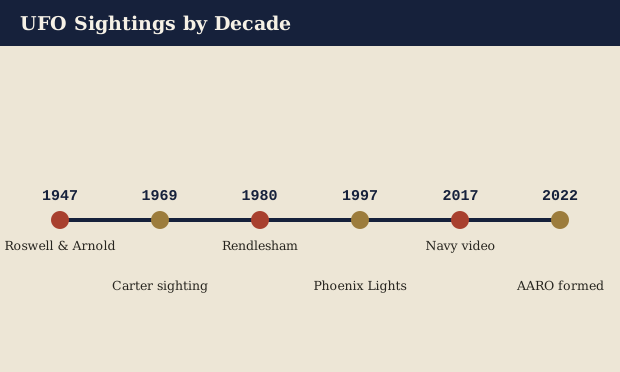
The word "flying saucer" showed up in 1947, after a pilot named Kenneth Arnold said he saw nine strange objects flying near Mount Rainier in the United States. He described them moving "like a saucer skipping across water." Newspapers loved the phrase, and it stuck. That same year, a much stranger story came out of Roswell, New Mexico, where the military first said it had recovered a "flying disc," then quickly changed the story to a weather balloon. That flip-flop is a big reason Roswell is still talked about today.
The 1950s and 1960s: Cold War Skies
During the Cold War, both the United States and the Soviet Union were testing fast new aircraft and spy planes. A lot of what people saw in the sky during this time really was secret military hardware, just not labeled that way to the public. The U.S. Air Force ran a project called Blue Book from 1952 to 1969, collecting thousands of reports. Most were explained as aircraft, weather balloons, or bright stars. A small number were not, and those are the cases that still get discussed by researchers.
Foo Fighters and Radar Confusion
Some of the strangest reports from this stretch of decades actually trace back even earlier, to pilots in World War II who reported glowing balls following their planes. We cover this in detail in our piece on UFO sightings during WWII, because it set the pattern for how the military would investigate these reports for decades afterward.
The 1970s and 1980s: The Public Gets Curious
By the 1970s, UFOs had become part of pop culture. Movies, books, and talk shows all fed public curiosity. Reports during this period often came from ordinary people in rural areas, describing bright lights that moved in ways normal aircraft did not. Investigators in this era leaned more on ground radar and witness interviews than on video, since home cameras were still rare and expensive.
The 1990s and 2000s: Video Cameras Change Everything
Once camcorders and then early digital cameras became common household items, the type of evidence changed. Instead of just written witness statements, researchers started getting shaky home video. A famous case from 1997, sometimes called the Phoenix Lights, involved thousands of people in Arizona watching a huge V-shaped formation of lights cross the night sky. It remains one of the most witnessed events in UFO history.
The 2010s and 2020s: Military Footage Goes Public
The most recent shift has come from an unexpected source: official military video. In 2017 and again in the years since, the U.S. Navy confirmed that footage taken by fighter jet cameras, showing fast-moving unidentified objects, was real footage and not fake. This pushed the U.S. government to create a formal office to study these events, which we explain fully in our article on what AARO stands for. For the first time, sightings were being investigated with radar data, infrared cameras, and pilot testimony all reviewed together by a government team.
What Ties Every Decade Together
Across eighty years of UFO sightings by decade, a few patterns repeat. Most reports turn out to have a normal explanation, like a weather balloon, a bright planet, or a new type of aircraft the witness had never seen before. A small number stay unexplained even after a proper investigation. That small leftover group is what keeps researchers, pilots, and now government agencies interested. If you want to see how these numbers actually break down, our page on UFO sighting statistics by year lays out the raw figures.
How Investigation Methods Changed Alongside the Sightings
It helps to notice that the tools used to investigate a sighting have changed just as much as the sightings themselves. In the 1940s and 1950s, an investigator had little more than a witness's memory, maybe a hand-drawn sketch, and a few interviews with neighbors. By the 1970s, ground radar stations gave investigators a second data source to check a story against. Once camcorders arrived, video became part of the file. And once the military started sharing infrared cockpit footage in the 2010s and 2020s, investigators finally had radar tracks, thermal imaging, and pilot audio all bundled together for the very first time.
This matters because it changes how much weight a report from each decade can fairly carry. A single 1952 witness account and a 2021 radar-confirmed Navy video are both technically "UFO sightings," but they are built from very different kinds of evidence, and a careful researcher treats them differently for exactly that reason.
Regional Patterns Across the Decades
Different decades also produced different geographic hotspots. The 1940s and 50s saw reports clustered near new military test ranges in the American Southwest. The 1970s and 80s produced a wave of European cases, including the well-known Belgian triangle sightings. The 1990s brought attention to the American Southwest again with the Phoenix Lights. And the most recent wave of reports has come disproportionately from Navy pilots training over open ocean, where radar coverage is excellent and there is very little clutter from birds, balloons, or ground traffic to confuse the picture.
Frequently Asked Questions
Which decade had the most reported sightings?
Civilian databases show report numbers climbing steadily from the 1990s onward, partly because cameras and internet reporting made it far easier for an ordinary person to log a sighting. That doesn't necessarily mean more strange things were actually happening in the sky; it mostly reflects how much easier reporting became.
Which decade produced the most reliable evidence?
Most researchers would point to the most recent decade, thanks to the combination of radar, infrared video, and trained military observers now involved in top-tier cases.
Where to Go Next
If a decade above caught your attention, it is worth reading the full story behind it. The wartime "foo fighter" sightings, the ancient reports that came long before any decade timeline starts, and the modern military videos are each covered in more depth elsewhere on this site.